
Half Fiction, Half Dead.
Understanding the many versions of myself.

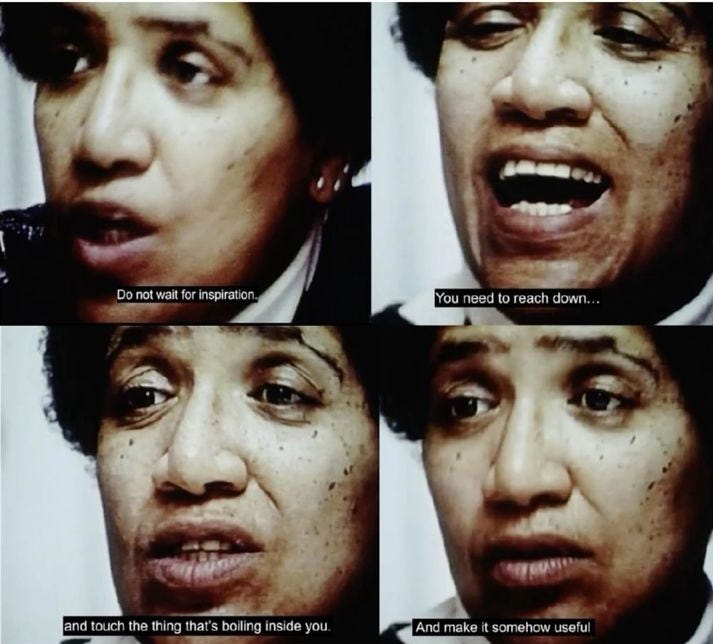
I write entirely to find out what I’m thinking, what I’m looking at, what I see and what it means. What I want and what I fear - Joan Didion.
I don’t think I’m all that good at personal essays. I used to believe it was my strong suit because I’d been so tightly wound up in the world of fictional women who relished in their self-importance. I wanted to be self-important. I am self-important. Translating such an unrefined sensibility is hard, especially as a young girl who can only be honest when she is self-critical. When I started writing personal essays, I noticed a pattern in my writing that had only grown more greedy since joining Substack: I had an affinity for languishing. It wasn’t over the top, because then I would notice, which meant everybody would notice, but it was faint, light dustings of woeful romanticisation. Much of my sadness was comforted by mystery, a language vague enough that I would never have to put into words what I was really feeling. Then, after bloating my essays with paragraphs of ambiguity, I realised I had no space for the real thing. The real thing wasn’t as pretty.
Now, however, after dipping my toes back into cultural analysis, I still feel that fatalistic self-importance that appears when throwing yourself to the wolves. You give your flesh for others to gnaw on, but nobody bites. Do I not taste good? You bite yourself. You rip into your own body and gnash at your bones, hoping to crack through and release the soft inner marrow. My marrow was still hidden in all the things I’d written for The Audience. Hidden far behind the performance of authenticity was my truest self.
My performance, as it slowly unravelled, was merely instinct. After all, how could I know that I had more to say? The internet told me what to say, and after countless hours of scrolling, I would write something that was simply an amalgamation of all the thoughts I’d ingested throughout the day. In realising this, my impulse was to quit altogether. I’ve always been better at fiction anyway. Fiction is easy to disappear into. But I wasn’t doing a very good job there either. All my characters were made up of me, chopped and skewered on sticks of different shapes and sizes, just enough to be swallowed by willing readers. I wanted to be seen; I wouldn’t have spread myself across so many words if I didn’t. I just didn’t know how to do it honestly.
My last four essays have been the most honest pieces of writing I’ve put out on this platform, and even then, I can imagine that in a few years, I will look back at them and find an issue. I’m realising that this is okay. I want my opinions to evolve as I do. I expect that slowly I will become more honest with myself, more unfettered in my approach to writing for The Audience. I want to, truly. But I mythologise too much. It’s the greatest sin most writers commit, placing themselves in a position of unreachable aggrandisement, all the while fighting an impossible loneliness. Even now, I’m making it sound more dramatic than it is. How lonely it is to craft so many versions of yourself, especially because you are doing it to keep busy, keep awake. Once your eyes are closed, the subconscious filters out all that extra stuff and leaves you with yourself, curled up in a ball, staring up at your towering figure, curious about how you’ve been. You’ve left them inside for too long, you know. Without sunlight. They’re rotting, the real you, forced into the shadow to make room for that awfully bright light you insist on using to blind The Audience from the truth. I don’t blame you. I don’t blame myself. Oftentimes, we refuse to acknowledge the fact that there is something we aren’t acknowledging. The truth makes liars of us all.
Half Fiction, Half Dead is the title I’ve given to many things in the last year. An unfinished essay. A zine. And now this. I think it’s a good title, though it took me a while to realise what it means. The conclusion I’ve come to is that half fiction is where I live as a myth, absorbed in my own inventions and terrified of actualisation, and half dead is the blunt force of actualisation, living in a world where I have no choice but to be myself entirely. The things I love are being slowly subsumed by hungry, overfed beasts. I cling to my myths even as death surely follows because I need these stories to trail behind me long after I’m gone. I’m keeping a journal now, and I hope to one day pass it along to someone who needs it.
Living, the experience of it, is novel to me. Much of my young adulthood has been spent in cavernous online silos where I express the same thoughts as everyone else. All we do is think things through. A gift, truly, in these end times, is that of thinking, but it is also our greatest limit in the age of the internet. We’re all positioned at extreme ends of very different spectrums, constantly exposed to the worst of humanity that has been reconstructed into a perverse sort of entertainment; we don’t have to actually…live life, do we?
I think about this a lot, my own position in the world and how well I’m able to achieve my existence alongside everyone else’s. I’ve talked about how performing is second nature to me, and a part of that comes from the fact that I am often stuck in theory.
I love theory. I’ve been exploring sociological and critical theory for the past few months now as a part of my personal curriculum, but outside of that, I do not live. My life is not as colourful or as noisy as I’d like it to be. Research is a favourite hobby of mine, but I will admit that my allegiance to the internet has eroded my means of researching. I don’t go out enough, I don’t eat new foods, meet new people, or see new places. It’s very easy to throw myself headfirst into research papers by people who have done the exploration already, so that I can imagine in my mind’s eye what it would be like. I can mythologise.
But I am also aware of how dangerous this becomes. It’s one of the reasons I think many people don’t read philosophy or theory. Living in other people’s words for so long that your own slowly blends into the background is terrifying. You have to come up for air eventually, and when you do, all that is waiting for you is the quiet. I realise it sometimes after I’ve talked myself in circles about a TikTok video that sparks something in me. I could argue about the hypotheticals for hours. I think we all do. There’s a thrill in the extremism of a hypothetical. It could never be me! I could never do that! How do you know? How will you ever know if you keep arguing with strangers online?
I didn’t create any New Year’s resolutions this time around, but I’m conducting a series of experiments inspired by Anne-Laure Le Cunff, a neuroscientist who wrote the book Tiny Experiments as an alternative to goal setting. The idea is to set out experiments, tiny ones, of course, so that I can measure what changes occur as each variable dips or increases. Failure is less of a reflection of my abilities and more of a data point. I make a pact to carry out an action for a limited amount of time and track what happens regardless of the outcome. The goal is to understand what I’m capable of, rather than expecting an immediate capability where it isn’t promised. It’s exciting to feel both in control and unsure of the future. Setting up these small curiosities, asking myself questions about what it is I’m actually trying to achieve, makes it easier to work towards actualising an outcome.
Aside from the self-help rant, this essay is my reentry into the world of personal essays. It is also a promise to myself to relinquish that pesky desire for performance and embrace the wonder that comes with writing. Many of my projects take shape as I go, and I almost never have a fully formed piece until the moment I decide to put it out in the ether. I don’t think performing is the worst thing in the world; it’s surely given me the confidence one needs to be a little delusional on the internet, but I also think it’s taken something very precious away from me. And I’m entirely set on getting it back.
felt this so hard. wrote a dramatic personal essay last year that my grandma publicly commented “feels woe-is-me”. been afraid of writing personal essays since then haha
very much looking forward to more personal essays ! this was insanely good. you get at a soft spot (self-mythologizing) that I've thought a lot about in regards to being sad, but also applies certainly to writing in general (and writing about being sad)